





Índice
Pilates mat ou Pilates reformer : différences et avantages
Qu'est-ce qui est mieux, pratiquer le Pilates mat (au sol) ou le Pilates reformer (sur machines) ? C'est l'une des grandes interrogations concernant cette méthode, car il ne s'agit pas de disciplines différentes, mais de phases ou d'étapes de la célèbre méthode créée par Joseph Pilates. En fait, le Pilates mat, comme l'affirme Kathy Corey, une légende vivante du Pilates, le travail au sol serait l'étape finale de la méthode, lorsque la force, la technique et le contrôle suffisants ont été acquis pour travailler avec son propre poids corporel.
Ainsi, l'idéal serait de commencer à pratiquer le Pilates sur machines, qui assistent le mouvement et permettent de réaliser les exercices en toute sécurité et en apprenant la technique correcte, surtout en cas de blessures, de pathologies ou de limitations de mouvement. Et parmi les machines conçues par Joseph Pilates, le reformer est probablement la plus populaire et la plus polyvalente, bien qu'il y en ait d'autres : le Cadillac, la chaise, le baril ou le spine corrector (spécial pour le travail du dos).
Mais il est vrai que les cours de Pilates au sol ont popularisé cette méthode et en ont fait une discipline accessible à tous, car le coût des cours de Pilates sur machines est souvent beaucoup plus élevé. Dans pratiquement n'importe quelle salle de sport ou centre sportif, nous pouvons trouver des cours de Pilates au sol, tandis que le Pilates avec machines se limite généralement aux studios spécialisés ou aux clubs plus exclusifs.
Il est également vrai que, bien qu'il s'agisse de l'étape finale de la méthode, les cours de Pilates au sol actuels sont conçus pour un public général et incluent des adaptations pour tout type de condition physique, ce qui réduit l'intensité et le risque. Bien que, comme vous pouvez l'imaginer, il est plus difficile de se blesser lors d'une séance de Pilates sur machines, qui se déroulent généralement en petits groupes ou de manière personnalisée, ce qui les rend sûres et efficaces.
Les différences les plus importantes entre le Pilates mat et le Pilates sur machines
Voici un résumé des principales différences entre les deux types de Pilates, qui vous aideront à choisir l'un ou l'autre en fonction de vos objectifs ou de votre condition physique :
· Type d'entraînement. En Pilates mat, le propre poids corporel est utilisé pendant l'exécution des exercices, ce qui peut être un véritable défi pour ceux qui n'ont pas un grand contrôle corporel ni une bonne condition physique. C'est pourquoi il est si important que les cours soient dispensés par des professionnels certifiés en méthode Pilates capables de proposer des adaptations à tous. D'autre part, dans le travail de Pilates sur machines, on peut ajouter de la résistance, mais elles offrent également un soutien et beaucoup plus de contrôle, ce qui permet de réaliser un entraînement très intense ou avec un objectif très précis (par exemple, pour les danseurs ou les golfeurs) ou, tout le contraire, totalement thérapeutique.
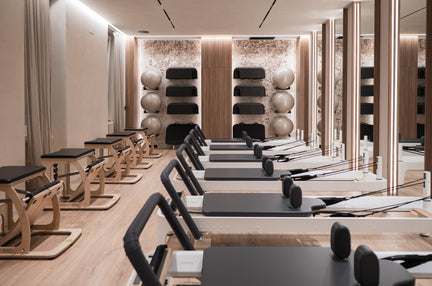
· Matériel. Le Pilates mat peut être pratiqué uniquement avec un tapis ou une natte, bien qu'il soit courant d'utiliser également des ballons ou des fitballs, des bandes élastiques ou des cerceaux de Pilates (magic circle). Le Pilates sur machines est généralement pratiqué surtout avec le reformer, une sorte de civière avec un chariot coulissant, des ressorts, des barres et des cordes avec des poignées, ce qui permet de faire de multiples exercices de Pilates avec contrôle, résistance et fluidité. Dans un studio de Pilates, vous trouverez normalement d'autres machines et accessoires, comme le Cadillac, une autre machine classique de Pilates, idéale pour des séances thérapeutiques.
· Cours. Les séances de Pilates au sol sont souvent en groupe, parfois trop grandes, ce qui rend difficile le suivi personnalisé et la correction posturale. Les cours de Pilates reformer ou en studios de Pilates se font en petits groupes voire individuellement, ce qui permet un travail totalement personnalisé, ce qui est, en réalité, l'essence de la méthode.
· Travail musculaire et exercices. Le Pilates au sol se concentre généralement sur le travail du core et sur le contrôle global du corps, tandis que les machines permettent de faire une grande variété d'exercices (la méthode en comprend des centaines) pour travailler toute la musculature du corps, même de manière isolée si nécessaire (par exemple, en cas de blessure, de déséquilibres ou pour améliorer un geste sportif).
· Approche des cours. Le Pilates sur machines a une approche clairement thérapeutique. En fait, c'est une méthode non seulement recommandée mais enseignée par des kinésithérapeutes dans le cadre de la rééducation des patients. Elle permet de traiter, d'améliorer et de prévenir toutes sortes de blessures. Au sol, l'effet thérapeutique est beaucoup plus limité et, si l'enseignant n'a pas la formation ou l'expérience suffisante, cela peut être contre-productif pour les personnes atteintes de pathologies ou de blessures.
· Coût. Le prix des cours de Pilates mat est beaucoup moins cher que celui des machines, et c'est même souvent une activité incluse dans l'abonnement des clubs sportifs. Cependant, étant donné leur personnalisation, les cours de Pilates sur machines ont un coût plus élevé, ce n'est donc pas une méthode accessible à tous.
Ce que le Pilates mat et le Pilates sur machines ont en commun
Beaucoup de choses ! Les deux types de Pilates font partie de la méthode originale créée par Joseph Pilates, pour qui le pratiquant devait commencer avec les machines et accessoires de Pilates afin de pouvoir, une fois le contrôle et la technique suffisants acquis, pratiquer au sol, l'étape finale.
Ainsi, le Pilates mat et le Pilates reformer ou sur machines devraient suivre les mêmes principes ou piliers de la méthode originale. Ce ne sont pas des disciplines distinctes, mais des phases ou des étapes d'un même système, où le travail au sol est une évolution du travail sur machines qui exige un plus grand contrôle et une meilleure maîtrise du corps.
Dans les deux cas, le pilier fondamental est le contrôle du core et l'exécution consciente du mouvement. Les deux types de Pilates exigent stabilité et précision, et recherchent l'harmonie corporelle. Avec les deux options, la musculature est tonifiée et allongée, la posture est améliorée, la force, l'endurance et la flexibilité sont accrues, la mobilité articulaire est améliorée et les pathologies posturales et dorsales sont prévenues.
Le Pilates mat et sur machines partagent également l'importance de la respiration et de la concentration, deux éléments clés de la méthode. La respiration est coordonnée avec chaque exercice et la connexion corps-esprit est constante, ce qui fait de la pratique un entraînement à la fois physique et mental qui augmente la concentration et la focalisation mentale.
Tant le Pilates mat que le Pilates au sol privilégient la qualité à la quantité et poursuivent les mêmes objectifs : améliorer la posture, la force équilibrée, la mobilité et la coordination. La différence ne réside pas dans les principes, mais dans le niveau d'exigence et de contrôle requis à chaque étape.
Comme vous l'avez vu, le choix entre le Pilates mat et le Pilates sur machines dépend surtout de votre situation et de vos objectifs : si vous avez une blessure ou si vous avez besoin d'un entraînement spécifique ou plus sûr, la recommandation est le Pilates sur machines (comme le reformer ou le cadillac). Si vous n'avez aucune blessure et peu de budget, l'alternative peut être le Pilates au sol. Dans les deux cas, il est très important de pratiquer le Pilates avec des instructeurs certifiés qui suivent et respectent la méthode originale créée par Joseph Pilates.
VOUS POURRIEZ ÊTRE INTÉRESSÉ PAR


Legging bleu éclectique Annapurna
Legging 7/8 sans coutures avec effet gainant et taille haute


