






Índice
Not sure whether to practice yoga or Pilates? The good news is that you don't have to choose: both disciplines are complementary and, in fact, there are proposals such as yogilates, which merges the best of both. Even so, each has its own essence. That's why those who get hooked on Pilates tend to value its precision and technical approach, while those who connect with the more introspective energy of yoga tend to become true believers in the practice.
Although the two have things in common, Pilates doesn't have the spiritual component of yoga, nor does yoga have the machine work of Pilates, among other differences. One thing they share? That neither will ever go out of fashion for its great physical and mental benefits, although there are still those who do not differentiate well between the two disciplines. Yoga and Pilates are much more than stretching and relaxation practices, they are authentic lifestyles, something that can be confirmed by any yogi or Pilates practitioner.
The origins of yoga and Pilates
Understanding how yoga and Pilates came about can help us better understand their differences. While yoga is an ancient discipline with deep roots in tradition, the Pilates method is much more recent and was born with a clearly physical and therapeutic approach. In its origins, yoga was conceived as a path for meditation and the search for mental and spiritual balance, while Pilates emerged as a system for rehabilitation and learning efficient movement. These are key differences, although over time both practices have evolved and incorporated nuances that bring them closer together.
Yoga originated in ancient India thousands of years ago: some sources place its antiquity at more than five thousand years. Since then, it has been transformed without losing its essence: a system that integrates body, mind and spirit. Although it maintains this philosophical background, today more traditional styles coexist with more dynamic and movement-oriented ones, such as Ashtanga or Vinyasa, adapted to the rhythm and needs of modern life.
The Pilates method was developed at the beginning of the 20th century by Joseph Pilates. Its creator designed this system from knowledge of gymnastics, traumatology, ballet and even influences from yoga itself, combining muscle strengthening with mental control, breathing and concentration. The aim of Pilates is to work the deep muscles to improve stability and body balance, especially in the core or central area of the body. Therefore, it is commonly used as a support in rehabilitation, especially in cases of back pain or discomfort.
Main differences between yoga and Pilates
The most notable difference between yoga and Pilates is the spiritual component. Yoga is much more than a physical practice: it integrates body, mind and breath within a path of self-knowledge and personal development. Through the postures (asanas) and conscious breathing, not only physical strength and well-being are sought, but also mental calm, mindfulness and a deeper connection with oneself. In addition, yoga is part of a philosophical tradition that includes ethical principles such as the yamas, which invite us to reflect on how we relate to ourselves and others.
Pilates, on the other hand, lacks this philosophical or spiritual component and focuses on the body from a technical and functional perspective. Its main objective is to improve posture, strengthen the muscles, especially the core, and optimize the quality of movement. It is a method very focused on precision, control and body alignment, with a clear application in the field of physical health, rehabilitation and injury prevention.
Another important difference is in the way the body is worked. In Pilates, exercises are performed in a controlled and specific manner, focusing on specific muscles and stability. Yoga, on the other hand, tends to involve broader muscle chains, combining strength, flexibility and endurance in movements that can be more fluid or sustained, depending on the style practiced.
Finally, they also differ in the experience they offer to the practitioner. Yoga is usually experienced as a moment or space of introspection and pause, where breathing and attention play a central role. Pilates, on the other hand, proposes an experience more focused on body awareness and technical work, ideal for those seeking to strengthen their body, improve their posture and move more efficiently in their daily lives. This does not mean that Pilates does not have mental or emotional benefits, since during the practice body and mind must be connected, which helps us to be present and silence the mental noise.
The benefits of practicing yoga
As we discussed in detail in our post about the benefits of yoga, its practice is very positive and beneficial physically, mentally, emotionally and even spiritually. And is that yoga is a complete discipline of physical and mental conditioning that improves balance, strength and flexibility in both the body ... and in the mind. And all the external improvements that occur in yoga also transform us internally.
More benefits? Yoga classes include breathing practices (pranayama), relaxation and moments of meditation, which help us to control stress and release tension, as well as increase our self-awareness and state of presence in our daily lives. For their part, the asanas or yoga postures improve our physical condition, stimulate the functioning of internal organs and help the body to purify itself.
Practicing yoga also makes the spine more flexible and stronger, improves posture, slims the body, burns calories in dynamic styles and makes us look younger. In fact, yoga is considered the anti-aging discipline par excellence, as we told you in this post about yoga as a modulator of internal aging.
The practice of yoga also clearly improves the functioning of the different physiological systems of the body: it strengthens the immune system, regulates blood pressure, improves your metabolism and digestion, increases your quality of sleep, mental clarity and general sense of well-being.
Not to mention the happiness that practicing yoga provides, since this discipline cultivates the concept of santosha or inner contentment, that joy and happiness linked to a state of peace and inner abundance. Yoga can also awaken our spiritual side. Beyond exercise, its practice invites us to look inward, to listen to ourselves and to reconnect with a deeper part of ourselves. All this without any kind of imposition or concrete belief.
The benefits of practicing Pilates
Pilates stands out as one of the most effective disciplines to strengthen the body in an intelligent and safe way, especially when practiced with machines. Its main objective is to work the deep muscles, especially the core, which results in improved posture and greater body stability. This strengthening of the internal musculature also improves our body hygiene on a daily basis and during the practice of other sports, which reduces the risk of injury and protects the spine.
In fact, one of the greatest benefits of this method is the prevention and relief of back pain and pathologies. By strengthening the muscles that support the spine, Pilates helps to correct postural imbalances and reduce accumulated tension, which is especially valuable in sedentary lifestyles or for people who spend many hours in front of screens.
In addition, the Pilates method improves coordination, body control and quality of movement. Pilates is not just about exercise, but about learning to move better. This allows you to re-educate movement patterns, activate muscles that are often "disconnected" and avoid overloading other areas of the body. As a result, the body functions in a more balanced and harmonious way.
Breathing also plays a key role. In Pilates it is deep, controlled and coordinated with each movement, which favors the activation of the core and also strengthens the pelvic floor. In addition, this type of breathing helps to improve concentration and keep the mind focused throughout the practice, making it a more conscious experience that also helps us to calm mental noise and train attention.
As Joseph Pilates said, "in 10 sessions you will notice the difference, in 20 you will see the difference and in 30 you will have a new body". This quote perfectly reflects the philosophy of his method: it is not about immediate or superficial results, but about a progressive and deep transformation of the body through constancy, control and precision in movement.
What equipment do you need to practice these disciplines?
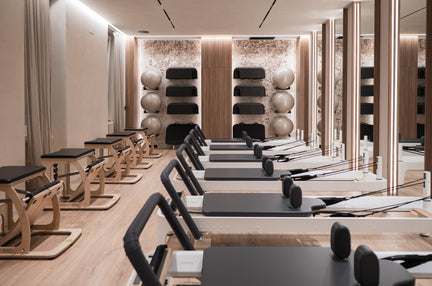
Among the differences between yoga and Pilates are also the accessories needed for both practices. Although both disciplines can be performed with almost no equipment, the original Pilates method begins with the practice on machines, such as the reformer or the cadillac, and with accessories such as hoops and balls. Pilates mat or floor Pilates would be the final step, when we have a good body control. Hence the importance of first learning the correct execution of the exercises on machines to avoid injuries on the floor.
In the practice of yoga, the weight of the body itself is the main protagonist. But there are also accessories that help to adapt the postures and make the practice more accessible and safe, especially for beginners or people with less flexibility: blocks, straps, blankets, chairs or cushions allow you to adjust the asanas, improve alignment and deepen the practice progressively. On the other hand, yoga promotes personal self-practice or sadhana, something that also differentiates this discipline from Pilates. With a yoga mat, you can practice anytime, anywhere.
As we told you before, one of the most distinctive features of Pilates is the use of machines designed specifically for this method. Machine Pilates adds extra resistance and control, allowing you to strengthen your muscles in depth, improve flexibility and work with even greater precision without the risk of injury. This makes it a particularly interesting option both for those looking for a more complete workout and for rehabilitation or physical rehabilitation processes.
Which discipline is better?
After all we have seen in this post we return to the initial question: yoga or Pilates? As we have seen, although they are different disciplines, they also have many points in common. Both help to improve posture and body alignment thanks to the work of the central area of the body (core), key to move better and prevent injuries. In addition, both yoga and Pilates help to improve joint mobility, flexibility and body awareness, fundamental aspects to maintain a good quality of life. And in both disciplines there are different styles and levels, which allows them to adapt to all types of people and objectives.
So which one to choose? The answer depends largely on what you are looking for at the moment. If you feel like a more introspective practice, combining movement with breathing, which helps you disconnect from daily stress and also allows you to connect with your spiritual side, yoga can be a great option. If, on the other hand, you want to focus on strengthening your body, improving your posture or recovering from physical discomfort or back problems, Pilates may be the answer.
What's better? You don't have to choose. In fact, combining the two can be the key to getting the best of both: Pilates will help you build a solid, stable foundation, while yoga will give you flexibility, balance and connection with yourself. Combining them in your weekly routine can give you a much more complete vision of caring for your body, mind... and soul.
Not to mention that, in the end, the best discipline for you will be the one that you enjoy, that you can maintain over time and that fits your lifestyle. Because beyond the differences, both yoga and Pilates share something essential: they are tools to feel better, move better and live with greater well-being.
YOU MAY BE INTERESTED IN


Top Eris Tea
Seamless sports bra with medium-high support. Semi-square neckline. Removable cups


