















Índice
Can yoga be considered a sport?
We can define yoga as a philosophical system, as a lifestyle, as a discipline of physical, mental and spiritual self-care, but not as a sport. The confusion comes from the practice of asanas or postures that, indeed, can resemble a physical practice that allows to improve general physical condition. But the differences with a sport practice, as we will see in this article, are many and very deep.
To contextualize the debate, it will help to know the definitions of yoga and sport. According to the RAE, sport is "physical activity, exercised as a game or competition, the practice of which involves training and submission to rules". It also defines it as "recreation, pastime, pleasure, amusement or physical exercise, usually outdoors".
On the other hand, the RAE defines yoga as the "set of physical-mental disciplines original from India, aimed at achieving spiritual perfection and union with the absolute". The RAE adds: "Set of modern practices derived from Hindu yoga and aimed at obtaining greater efficiency in the mastery of the body and soul concentration".
As we can see, yoga includes the care of the body and mind, but transcends the purely physical by incorporating a spiritual dimension that is not part, at least in an essential way, of sports practice.
Yoga vs. sport: similarities and differences
The spiritual dimension of yoga already marks a key difference. But it is true that yoga, especially in the West, has become very popular as a physical practice, especially with styles such as Hatha, Vinyasa or Ashtanga, which emphasizes the performance of asanas or postures, static or moving. In fact, some of these styles can be very challenging and physically demanding, and also involve an improvement of physical qualities such as strength, flexibility, balance or coordination, as well as stimulating the different physiological systems.
However, unlike sports, in yoga there is no concept of competition, nor are there fixed rules, or even a specific goal. It is true that both, yoga and sport, are healthy practices that bring general well-being and improvement of physical and mental health. To make it clearer, here are the main differences between yoga and sport:
- Physical effort. In the practice of sports we propose to overcome our own limits and marks, while yoga invites us to listen to the body, respecting its limits without forcing it. In the practice of yoga the changes are produced slowly, without demands.
- Body work. Some types of sports can unbalance the body muscularly due to certain repetitive movements, while yoga works the body as a whole and in a harmonious way, resulting in a balanced musculature, improved posture and all physical qualities.
- Comparison. The sport includes the concept of competition, with oneself and with others, while in yoga competition and comparison with others disappear, each practice is personal and there is no classification or performance to measure.
- Physical canons. Some sports practices seek to achieve certain canons of beauty and may even induce the cult of the body, while in yoga beauty is a concept that goes beyond the physical, which is linked to an inner state of balance and serenity.
- Spirituality. The sport helps in the emotional management and improves the mental state, something that also occurs in yoga. But this discipline also has a strong spiritual component that each practitioner is discovering at their own pace.
- Awards. Sport can involve competitions, medals, awards or tournaments, something that does not exist in yoga. In the practice of yoga there are no prizes, the ultimate goal is to achieve the state of samadhi, described in the Yoga Sutras of Patanjali as a state of full consciousness or integration.
Yoga: a holistic approach to wellness
As you have seen, the practice of sport is mainly based on physical effort and can have different objectives: health, performance, competition or simply fun. Its benefits are unquestionable: it improves cardiovascular capacity, strengthens muscles, enhances discipline and promotes emotional well-being, increasing self-esteem and a sense of personal achievement.
Yoga, on the other hand, does not focus exclusively on physical conditioning. Although it also strengthens, flexes and improves endurance, its approach is holistic: it works on our physical, mental, emotional, energetic and spiritual dimensions at the same time. It is not only about "being in shape", but also about inhabiting the body with awareness, regulating the nervous system, cultivating mindfulness and developing a kinder relationship with ourselves.
Yoga also integrates a series of practices that broaden and deeply enrich the experience beyond the physical work. These include pranayama or conscious breathing techniques, deep relaxation, meditation and mudras (energy seals or gestures), tools that act directly on the nervous system and the quality of our attention. Added to this is the impressive philosophical framework that sustains this millenary discipline, where we find the yamas and niyamas - ethical principles and personal observance described by Patanjali - as well as practices of devotion, gratitude and self-inquiry present in the most spiritual currents. All this reminds us that yoga is not limited to performing asanas, but proposes an integral path of transformation and self-knowledge.
If we place it within the pyramid of physical exercise, yoga can occupy different levels according to style and intensity. The more dynamic practices, such as Vinyasa or Ashtanga, would fit into the intermediate level, along with strength work and moderate aerobic activity recommended several times a week. The more gentle, restorative practices, or those focused on breathing and mobility, would be placed as a regular basic activity, favoring recovery and reducing sedentary lifestyles. Thus, yoga not only complements other sports disciplines, but can become a pillar within an active and balanced lifestyle.
The most physically demanding yoga styles
Although it is not the main objective, there are styles of yoga that will challenge you physically. There are even disciplines that merge yoga and fitness or in which weights are used. These are the most physically demanding types of yoga, with which you will work especially the strength, with which you will activate your metabolism and burn calories, and with which you can get to do a gentle aerobic work without impact, We speak especially of dynamic yoga practices, in which breathing is coordinated with the movement while linking asanas as in a kind of series or choreography. If you want to try more physically demanding yoga sessions, take note:
- Vinyasa Yoga. Actually, it is a generic name for yoga styles that include dynamic sequences, called "vinyasa", in which movement is combined with breathing. In this type of sessions you work the entire musculature of the body with your own body weight; you gain strength, endurance and flexibility, you do gentle aerobic work and you also get to calm and balance the mind. Asthanga, Jivamutki, Dharma, Rocket, Power or VInyasa Flow are included in this style.
- Ashtanga Yoga. It is one of the most athletic and physically demanding yoga styles because it is based on the practice of powerful dynamic sequences or vinyasas. There are several fixed series of postures that are done in a defined order as self-practice, i.e., unguided or Mysore. Ashtanga classes can become authentic moving meditations.
- Power Yoga. This is an intense, physical and challenging style of yoga originating in the United States and based on Ashtanga Yoga. It is a practice more adapted to the West in which series of intense and energizing movements are performed.
- BikramYoga. It is based on a series of 26 postures practiced in a room with a temperature of 40 degrees and a humidity of 40%. It is one of the most demanding and challenging styles of yoga.
In conclusion, if we take into account the definitions and characteristics of each practice, yoga cannot be considered a sport: although it includes exercise and movement, improves physical condition and can be demanding, its purpose is not competition or performance. Yoga is, above all, a path of self-knowledge and personal transformation. While sport is usually oriented towards external goals and measurable results, yoga proposes an inner journey in which the process itself has more value than the goal. Both practices are healthy, compatible and complementary, but different in essence. As Sri K. Pattabhi Jois reminds us: "Practice and all will come", a phrase that sums up the spirit of yoga: constancy, presence and confidence in the process, beyond any external achievement.
YOU MAY BE INTERESTED IN





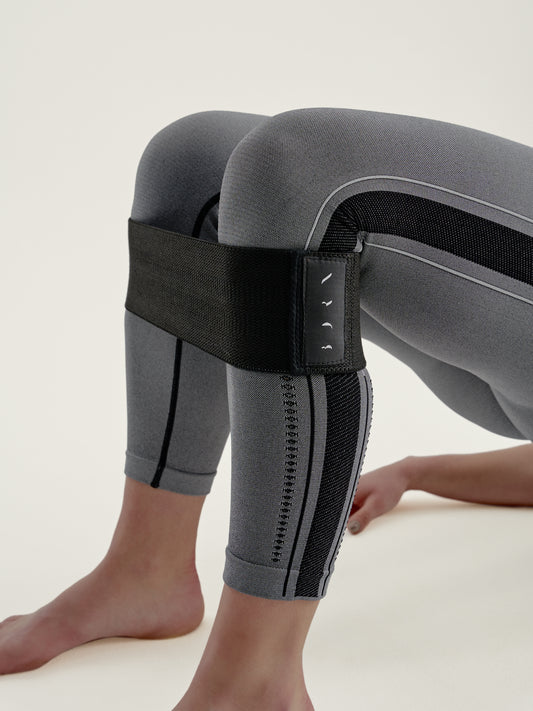
Resistance Bands Set Black & Medium Grey
Pack of two non-slip latex inner support resistance bands